From AI Research to Production: Why DevOps Is Essential
Artificial Intelligence (AI) has rapidly transitioned from experimental research to production-grade systems powering real-world applications such as recommendation engines, fraud detection, computer vision, and conversational AI. However, deploying and operating AI services at scale is fundamentally different from traditional software systems. This is where DevOps plays a critical role in bridging the gap between AI development and reliable production operations.
“DevOps is the bridge that turns AI experiments into reliable, real-world systems.”
Why AI Needs DevOps More Than Ever
AI systems are inherently complex. They involve not only application code, but also:
- Large datasets
- Trained machine learning models
- GPUs and specialized hardware
- Continuous model updates and retraining
Without DevOps practices, AI deployments often suffer from instability, poor scalability, and long release cycles. DevOps introduces automation, observability, and reliability into the AI lifecycle.
Infrastructure as Code for AI Platforms
Modern AI services rely heavily on cloud-native infrastructure. DevOps engineers use Infrastructure as Code (IaC) tools to provision and manage environments in a repeatable and version-controlled manner.
Popular tools include:
- Terraform: https://www.terraform.io/
- Ansible: https://www.ansible.com/
With IaC, AI teams can spin up GPU-enabled clusters, storage systems, and networking configurations consistently across development, staging, and production environments.
Containerization and Kubernetes
Containerization is the foundation of scalable AI deployments. By packaging models and inference services into containers, teams ensure consistency across environments.
Kubernetes has become the de facto standard for orchestrating AI workloads:
- Auto-scaling inference services
- Efficient GPU scheduling
- Rolling updates without downtime
Learn more:
- Docker: https://www.docker.com/
- Kubernetes: https://kubernetes.io/
For AI-specific workloads, Kubernetes enables advanced platforms such as:
- Kubeflow: https://www.kubeflow.org/
CI/CD for Machine Learning (MLOps)
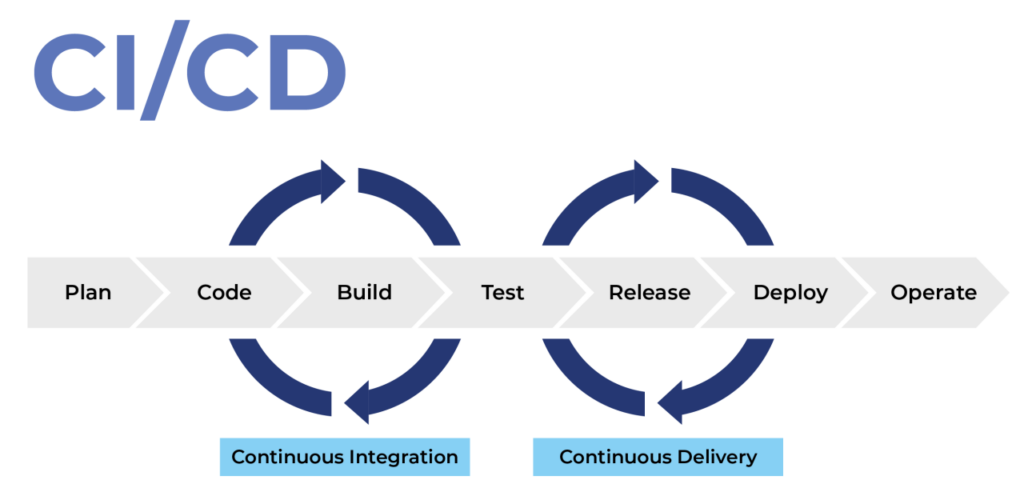
Traditional CI/CD pipelines are not enough for AI systems. DevOps extends these pipelines into MLOps, enabling:
- Automated model training and validation
- Versioning of models and datasets
- Safe deployment of new models into production
Tools commonly used in MLOps pipelines include:
- MLflow: https://mlflow.org/
- GitLab CI/CD: https://docs.gitlab.com/ee/ci/
- Argo CD: https://argo-cd.readthedocs.io/
With proper CI/CD pipelines, AI teams can move from experimentation to production with confidence and speed.
Monitoring, Logging, and Model Observability
Once deployed, AI services require continuous monitoring. DevOps practices ensure full observability across:
- System metrics (CPU, memory, GPU usage)
- Application logs
- Model performance and drift
Key monitoring tools:
- Prometheus: https://prometheus.io/
- Grafana: https://grafana.com/
Advanced AI observability helps detect issues such as model degradation, data drift, and unexpected behavior before they impact users.
Security and Reliability in AI Systems
AI services often handle sensitive data. DevOps integrates security directly into the pipeline using DevSecOps principles:
- Secrets management
- Secure container images
- Access control and network isolation
By automating security checks and enforcing best practices, DevOps ensures AI platforms are not only scalable, but also secure and compliant.
Conclusion
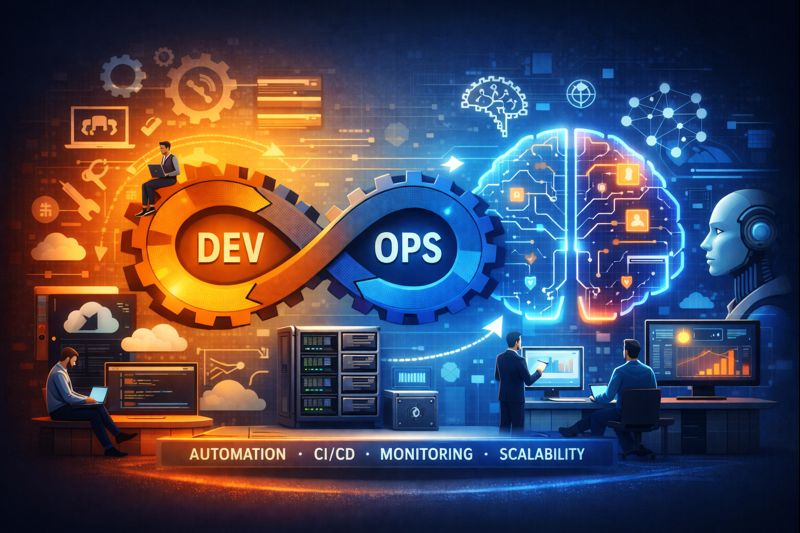
DevOps is no longer optional for AI-driven organizations. It is a foundational enabler that transforms AI models into reliable, scalable, and production-ready services. By combining automation, cloud-native infrastructure, CI/CD, and observability, DevOps empowers teams to deliver AI solutions faster, safer, and at scale.
As AI adoption continues to grow, the collaboration between DevOps and AI engineering will be a key competitive advantage for modern technology companies.