
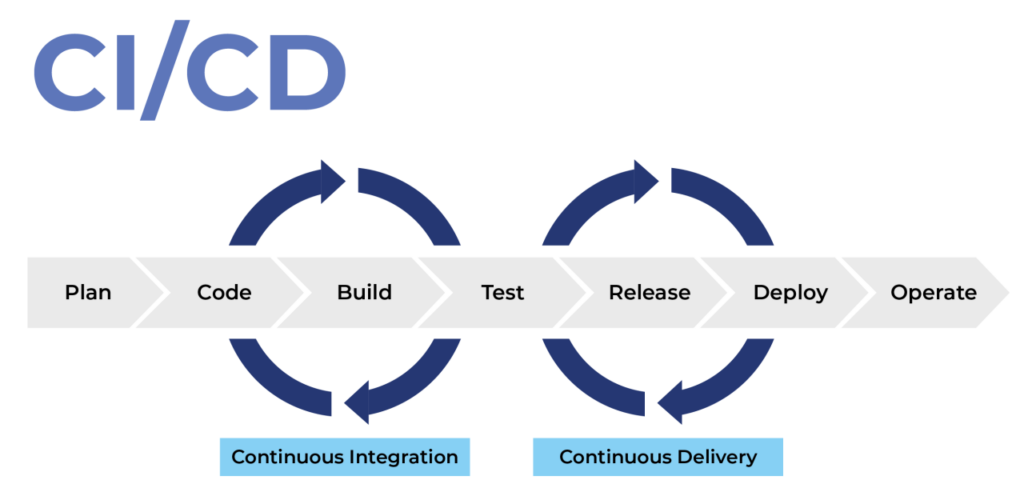
Code to Production – DevOps View
Modern software development is no longer just about writing code. Delivering a reliable, scalable, and secure product to production requires a well-defined process that spans from initial development to final launch. DevOps plays a central role in connecting development and operations, ensuring that software moves smoothly, safely, and quickly from idea to production.
“DevOps is not a phase — it is the pipeline that connects every phase.”
Understanding the DevOps Software Lifecycle
From a DevOps perspective, software development is a continuous lifecycle rather than a linear process. This lifecycle typically includes:
- Planning and design
- Development
- Continuous Integration (CI)
- Continuous Delivery and Deployment (CD)
- Testing and quality assurance
- Monitoring and feedback
DevOps ensures that these stages are automated, observable, and tightly integrated.
Planning and Collaboration
DevOps begins even before the first line of code is written. Early collaboration between developers, operations, and business stakeholders helps define:
- Infrastructure requirements
- Deployment strategies
- Scalability and availability goals
Tools like Jira and Git-based workflows help teams align from day one:
Development and Version Control
During development, DevOps emphasizes consistency and traceability. All code, configuration, and even infrastructure definitions are stored in version control systems.
Common practices include:
- Git-based branching strategies
- Code reviews and pull requests
- Automated linting and security checks
Learn more:
Continuous Integration (CI)
Continuous Integration is the backbone of DevOps. Every code change triggers automated pipelines that:
- Build the application
- Run unit and integration tests
- Perform static code analysis
CI reduces integration issues and provides fast feedback to developers.
Popular CI tools:
- GitHub Actions: https://github.com/features/actions
- GitLab CI/CD: https://docs.gitlab.com/ee/ci/
Continuous Delivery and Deployment
Once code passes CI, DevOps pipelines prepare it for release. In Continuous Delivery, software is always deployable. In Continuous Deployment, releases happen automatically.
Key DevOps deployment techniques include:
- Blue-Green deployments
- Canary releases
- Rolling updates
Containerization and orchestration tools are essential here:
- Docker: https://www.docker.com/
- Kubernetes: https://kubernetes.io/
“If deploying software is risky, the process is broken — DevOps fixes the process.”
Infrastructure as Code and Environment Consistency
DevOps eliminates environment drift by defining infrastructure as code. This ensures that development, staging, and production environments behave consistently.
Widely used tools:
- Terraform: https://www.terraform.io/
- Ansible: https://www.ansible.com/
With IaC, teams can reproduce environments, recover faster from failures, and scale with confidence.
Testing, Quality, and Security (DevSecOps)
Testing in DevOps goes beyond functionality. Pipelines often include:
- Performance testing
- Security scanning
- Dependency vulnerability checks
Security becomes a shared responsibility through DevSecOps, embedding protection directly into the pipeline:
Monitoring, Observability, and Feedback
Launching software is not the end — it is the beginning of real-world validation. DevOps ensures continuous monitoring of:
- System health and performance
- Application logs
- User experience and error rates
Essential observability tools:
- Prometheus: https://prometheus.io/
- Grafana: https://grafana.com/
Launch Day and Beyond
From a DevOps viewpoint, a successful launch means:
- Zero or minimal downtime
- Fast rollback in case of failure
- Immediate visibility into system behavior
Post-launch feedback feeds directly into the next development cycle, creating a continuous improvement loop.
Conclusion
DevOps transforms software development from a risky, manual process into a predictable and scalable system. By automating workflows, enforcing consistency, and enabling rapid feedback, DevOps ensures that software can move from development to launch — and beyond — with speed and reliability.
In today’s fast-moving digital landscape, DevOps is the difference between shipping software and sustaining it.